
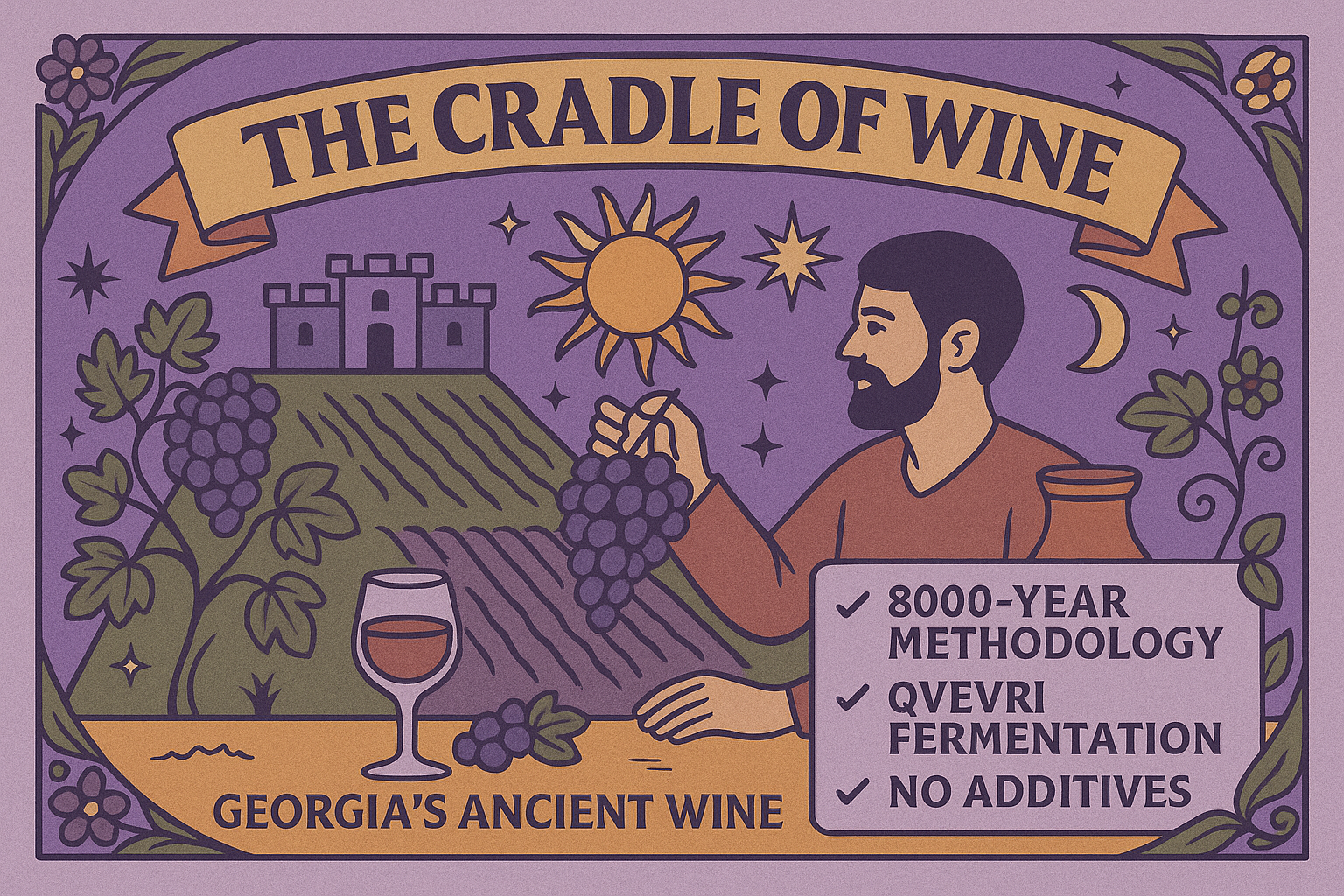
Georgia - where wine was born, 8000 years ago.
Most wine-producing countries have a history. Georgia has a mythology.
While France was still covered in forest and the Napa Valley was a millennia away from its first vineyard, a people called the Kartveli — the ancestors of modern Georgians — were already fermenting grapes in clay vessels buried deep in the earth. The date, confirmed through archaeological remains, is around 6,000 BCE. Eight thousand years ago. Before the wheel was widely used. Before most of recorded civilisation.
Turns out Georgia didn't just arrive early to winemaking. It invented it.
What makes Georgian wine different from everything else?
The short answer is the qvevri — pronounced kvev-ree; the enormous amount of diversity in grape varieties; and, the vast amount of tradition and love for the art of winemaking.
But, let's focus on thy qvevri first: a colossal terracotta vessel, handmade, sealed with beeswax, and buried underground so the earth itself regulates temperature year-round. Grapes go in after harvest. The vessel is sealed through winter. Come spring, what emerges has been transformed by time, clay, and fermentation in a way no steel tank or oak barrel can replicate.
But here's the part that surprises most people: in Georgia, white grapes are treated like red grapes. The skins, stems, and seeds stay in contact with the juice throughout fermentation. In most of the world, white wine is made by pressing the grapes immediately and fermenting only the juice. In Georgia, everything goes in together.
What does that actually change in the glass? Quite a lot.
The skin contact draws out tannin, texture, and colour. White grapes fermented this way produce what's known as amber wine — deep golden-orange, full-bodied, with a grip and complexity that white wine drinkers rarely expect. It's closer in structure to a red than to a Chablis. The first time most people try it, they don't quite know what category it belongs to. That's not a problem. It's the point.
500 grape varieties — and counting
France has around 250 documented grape varieties. Spain has roughly 400. Georgia, a country with landmass 10-12 times smaller than the latter 2, has over 500 — and that number keeps growing as winemakers venture into abandoned vineyards and rediscover varieties that nearly disappeared during the Soviet era.
Think about that for a moment. Five hundred distinct grapes, many of them found nowhere else on earth, shaped by eight thousand years of cultivation in one of the most biodiverse agricultural landscapes in the world. The diversity of flavour available in a single country is staggering.
Which raises an obvious question: why has it taken the rest of the world this long to notice?
The honest answer is hidden in history. Georgia's wine culture was industrialised and flattened under Soviet production quotas — volume over quality, consistency over character. The ancient traditions survived in family cellars and small farms, but the global reputation took decades to recover. It's recovering now, fast.
The styles you'll encounter
Amber wines are the most distinctively Georgian expression — white grapes fermented on skins in qvevri, producing deep colour, tannin, and remarkable texture. Rkatsiteli and Kisi are the grapes to know. Bold, walnutty, long.
Orange wines follow the same skin-contact method but use vessels other than qvevri — stainless steel, or rarely concrete/barrel. Lighter in character than amber, but still more textured than conventional white.
Georgian reds are built differently from what most drinkers expect. Varieties like Saperavi produce wines of deep colour and serious structure — almost inky, with a fruit profile that runs toward dark cherry, plum, and dried herbs. Not subtle. Not trying to be.
Rosés from Georgia are their own thing too: blends of white and red grapes fermented together in qvevri, producing hues that shift from deep copper to pale violet depending on the blend. They bear almost no resemblance to the pale Provençal rosé that dominates European wine lists.
And then there are the lighter whites from western Georgia — Tsitska, Tsolikouri, Krakhuna — crisp and high-acid, closer to what European drinkers expect from a white wine, but with a mineral character that's entirely their own.
UNESCO said it officially
In 2013, UNESCO added Georgian qvevri winemaking to its list of Intangible Cultural Heritage of Humanity - a big moment for the Georgian story. The recognition matters not just as a cultural accolade but as a statement about what's at stake: a winemaking tradition this old, this specific, and this irreplaceable deserves active protection.
If you ever visit Georgia — and you should — the grape appears everywhere. Carved into church facades, woven into jewellery, painted on walls. This isn't a country that produces wine. It's a culture built around it.
Why now
The natural wine movement and Georgian wine arrived at the same moment in European consciousness, and it wasn't a coincidence. Natural wine's rejection of industrial winemaking pointed directly back to Georgia — the place where natural winemaking never stopped. The country that didn't need a revival because it never let go of the original. Most families either make their own natural wine in Georgia, or have access to some from their relations.
Georgian wines are now reaching restaurants and wine bars across Europe, the US, and Asia. The export boom is real, and Georgia is small. But the best bottles — from small farms, in old qvevri, with grapes that don't appear on any other wine list in the world — are still found by people who go looking.
This is a good time to start looking.
At Kinto Natural, we work directly with small Georgian producers whose wines don't travel far or appear on many lists. We bring them to Berlin, and from Berlin, anywhere in Europe. Start with the Rkatsiteli from Lomtadze's Marani — it's one of the clearest single-bottle arguments for why Georgian wine matters.
Check out the bottle →
Or, if you are up for an exploration, try Orange Affair by Artizani, this wine is a journey of taste.
Check out the bottle →
FAQ
Is Georgia really the birthplace of wine?
Yes. Archaeological remains of qvevri containing grape residue have been carbon-dated to around 6,000 BCE, making Georgia the oldest confirmed site of winemaking in the world.
What is amber wine? How is it different from orange wine?
Both are made by fermenting white grapes with their skins — the skin contact gives colour, tannin, and texture. The distinction is the vessel. Amber wine is fermented in a qvevri (clay). Orange wine uses any other vessel. If it's not clay, it's not amber — at least not by Georgian definition.
How many grape varieties does Georgia have?
Over 500 documented indigenous varieties, with more being rediscovered as winemakers explore abandoned vineyards. Most are found nowhere else on earth.
Where should I start if I've never tried Georgian wine?
Rkatsiteli made in qvevri. It's the most widely planted Georgian white grape, and in the right hands it's one of the most distinctive white wines in the world.
Read our full Rkatsiteli guide →

Written by Otar Bedoshvili

Leave a comment
This site is protected by hCaptcha and the hCaptcha Privacy Policy and Terms of Service apply.