
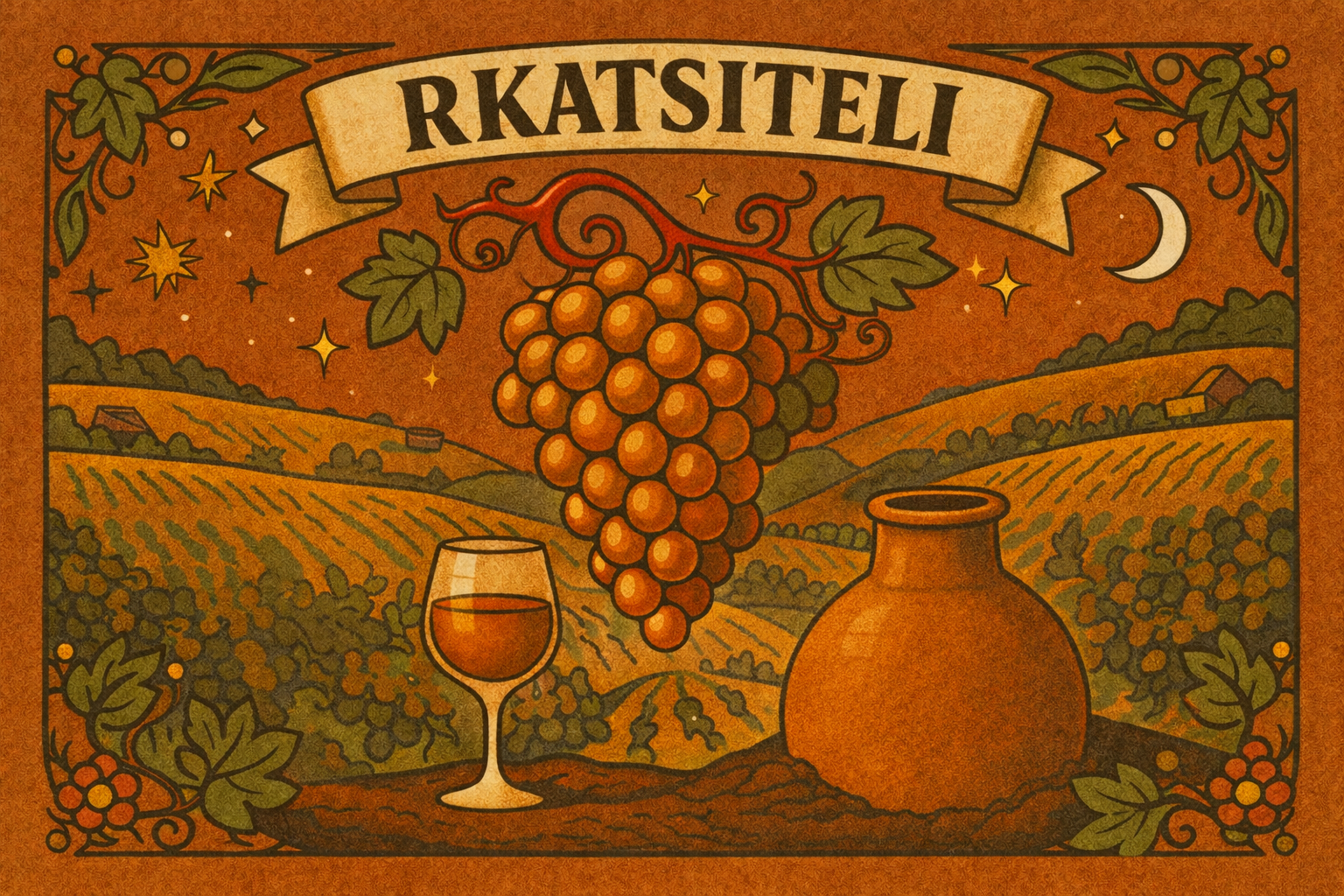
Rkatsiteli: the white grape at the heart of Georgian wine
If you’ve started exploring Georgian natural wine, you’ve probably come across the name Rkatsiteli. It appears on labels, in conversations, in the back sections of wine lists. It’s pronounced roughly rkah-tsee-TEH-lee — and once you’ve had a good bottle, it tends to stay with you.
Georgia has no shortage of remarkable white grapes — Mtsvane, Kisi, Chinuri, Khikhvi among them. But Rkatsiteli is the most widely planted, and for good reason. In the right hands, in the right place, made the right way, it produces some of the most distinctive and delicious white wine in the world.
What does Rkatsiteli mean?
The name is Georgian — რქაწითელი — and translates directly as Red Horn. This grape with golden yellow skin (when ripe) gets its name from the reddish, horn-shaped curls the stems form as they ripen on the vine. Once you know what to look for in a vineyard, the name makes immediate sense.
Where does it grow?
Rkatsiteli is remarkably adaptable. You’ll find it planted not just across Georgia but in California, Australia, France, and parts of Eastern Europe. That geographic spread speaks to its resilience — it handles cold winters, variable climates, and different soils without losing its fundamental character.
But adaptability doesn’t mean uniformity. Terroir has a significant effect on what Rkatsiteli becomes in the glass. The same grape, grown 200 kilometres apart within Georgia itself, produces wines that can feel almost unrelated.
Western Georgian Rkatsiteli tends toward lighter, fruitier expressions, though still deep and round it’s more delicate, more immediately approachable. Kakhetian Rkatsiteli — from Georgia’s eastern heartland, where most of the country’s wine has been made for millennia — is a different proposition entirely: bold, unapologetic, deep, rounded, intense, with a weight and richness that white wine drinkers rarely expect.
In a good season in Kakheti, this grape can produce amber wine exceeding 15% alcohol. For a white grape fermented naturally, without intervention, that’s genuinely rare.
Why is it so widely planted?
Three reasons, working together.
First, the vine itself is built for survival. Rkatsiteli tolerates harsh winters that would kill less robust varieties, holds its acidity through hot summers when other grapes lose structure, and performs across varied soils without complaint. Farmers plant what survives reliably, and Rkatsiteli survives reliably.
Second, the Soviet era locked it in at industrial scale. By 1978, Rkatsiteli accounted for roughly 18% of all Soviet wine production — used for everything from cheap table wine to fortified styles. Decades of mass planting across Georgia and beyond embedded the vine deeply into the landscape and the knowledge of growers. That kind of history doesn’t unwind quickly.
Third — and this is the part that matters for natural wine — its quality ceiling is exceedingly high. It can reach significant sugar levels while retaining the acidity needed for balance. In the hands of a small-farm producer working with qvevri, the same grape that was once churned out by the tanker-load becomes something entirely different: complex, age-worthy, deeply expressive of its origin.
The natural wine revival in Georgia is, in part, a reclamation of what Rkatsiteli was before industrialisation got hold of it.
What does it taste like?
This depends heavily on how it’s made. Conventional, stainless-steel Rkatsiteli — the kind you’d find in a supermarket from a large Georgian producer — is clean, crisp, fairly neutral. It’s a perfectly decent white wine and tells you almost nothing about what the grape is capable of.
Made naturally, with skin contact, and aged in a traditional Georgian qvevri, Rkatsiteli becomes something else. The colour shifts to deep amber. The nose opens into walnut, dried fruit, honey, autumn orchard. The texture is full and generous, with tannins that the qvevri has softened over months into something almost silky. The finish is long and direct — no funkiness, no off-notes, just the grape and the vintage expressing honestly.
It’s the kind of wine that surprises people who come to natural wine expecting something challenging. This is not challenging. It’s confident.
The qvevri: why it matters for Rkatsiteli
Qvevri are large terracotta vessels, buried underground, that Georgian winemakers have used for over 8,000 years. Fermentation and ageing happen inside the vessel, with the grape skins left in contact with the juice — a process that draws out colour, tannin, and texture in ways no other winemaking method replicates. The buried clay maintains a stable, naturally cool temperature throughout the whole process.
For Rkatsiteli specifically, the qvevri does something precise: it emboldens the grape’s natural character while simultaneously softening it. The tannins that would otherwise be sharp from the skin contact are rounded by the clay and the time. What you get is intensity without aggression.
The Norah’s Rkatsiteli from our collection is made in a qvevri that is over 100 years old, used by the Lomtadze family for multiple generations. Vessels like this are increasingly rare — old qvevri have a particular mineral quality absorbed from decades of use that newer ones simply don’t carry.
Does it age well?
Yes. Georgian Rkatsiteli made in qvevri has the structure to develop over years. The tannins and natural acidity give it a backbone that holds. That said, it doesn’t require ageing to be excellent — the Norah’s 2022 is at a very good drinking point now, with enough fruit and freshness to enjoy immediately, and more than enough variability during decantation to enjoy the subtle story it tells..
If you do have a bottle you’re considering cellaring: 3 to 5 additional years will likely reward you with more integration and a deeper honey-walnut character. Decanting before serving is worth the ten minutes regardless.
Who is it for?
People who drink aged white Burgundy, skin-contact Italian whites, or oxidative styles like Jura Savagnin tend to connect with Rkatsiteli immediately. The textural weight and savoury-fruit profile sits in familiar territory.
It also works well as an entry point for drinkers who are curious about natural wine but wary of volatility or fault. Rkatsiteli from a good maker is clean, precise, and expressive within the vintage. There’s nothing to brace for.
Food-wise: think roasted vegetables, aged cheeses, walnuts and pomegranate (very Georgian). The tannin structure means it can handle more than most white wines.
Our Norah’s Rkatsiteli 2022 is made by the Lomtadze family in Velistikhe, Kakheti, Georgia, in a century-old qvevri. Skin contact, no sulphites added, wild yeast fermentation. Deep amber, full-bodied, honest, Georgian.
Check out the bottle →

Written by Otar Bedoshvili



Leave a comment
This site is protected by hCaptcha and the hCaptcha Privacy Policy and Terms of Service apply.